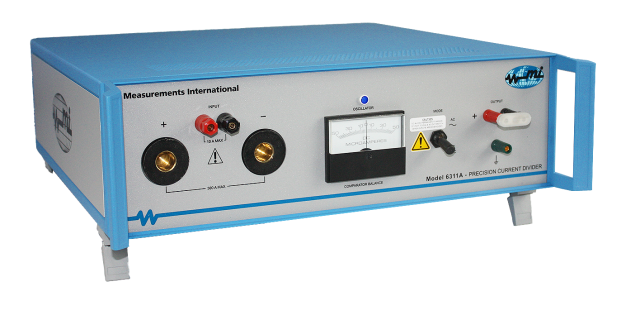
6311A Precision Current Divider
6311A Precision Current Divider
- 10A (100:1) and 300A (1000:1) ranges
- No stabilization period
- No power coefficient
- No temperature coefficient
- DC and AC operation
- Replaces current shunts
Measurements International replaced the outdated current shunts with the 6311A Precision Current Divider, which improves both the DC and AC current measurements . The 6311A offers a simple and accurate method to measure currents without the significant drawbacks of using a current shunt. Traditional current shunts suffer from large temperature and power coefficients, affecting stability and requiring a longer stabilization period. The current transformer used in the 6311A has no such issues; simply apply power and measure the divided output.
The 6311A builds upon the world-renowned DC Current Comparator (DCC) that is the heart of every MI resistance bridge and range extender. Leveraging two sets of primary windings of a DCC, the current is accurately divided by either 100:1 or 1000:1, providing a more measurable signal.
The 10A max range divides the input current by 100 range while the 300A max range divides the input current by 1000. Both ranges can accept both DC and AC current to 1 kHz with an uncertainty of < 5 and < 20 parts in 106 respectively. Comparatively, a DC current shunt has a calibration uncertainty of 0.01 % or larger in most cases.
No temperature coefficient
-
Reduces uncertainty
No stabilization period
-
Measurements can be made immediately
No power coefficient
-
No error difference from 5 % to 100 % of range
AC/DC
-
Works at DC and AC up to 1kHz
CT/Current Divider
-
Current In is divided by either 100 or 1000
< 5 ppm (DC) / 20 ppm (AC)
-
∼ 20 times less than a traditional Current Shunt
Read the technical paper, Improving the Uncertainty of DC Current Measurements, showing the comparison of shunts to current divider technology.