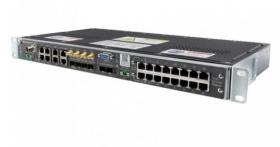
Microchip TimeProvider® 4100 - Reliable PTP Grandmaster for 5G, Utilities and Critical Infrastructure
Thu 16.07.2026
Microchip TimeProvider® 4100, supplied and supported by Amtest‑TM, is a proven solution for customers who require:
nanosecond-level accuracy
resilience against GNSS outages
scalable and secure timing architecture
seamless integration of modern and legacy technologies
Microchip TimeProvider® 4100
Reliable PTP Grandmaster for 5G, Utilities and Critical Infrastructure
Modern networks are more dependent on precise timing than ever before. Whether in 5G mobile networks, power utilities, industrial systems, or transportation infrastructure, accurate time synchronization is essential for performance, stability, and security.Microchip TimeProvider® 4100, supplied and supported by Amtest‑TM, is a proven solution for customers who require:
- nanosecond-level accuracy
- resilience against GNSS outages
- scalable and secure timing architecture
- seamless integration of modern and legacy technologies
Why choose TimeProvider 4100
TimeProvider 4100 is more than just a PTP Grandmaster - it is a complete timing platform that integrates multiple synchronization technologies into a single system:
- PTP Grandmaster (IEEE 1588 v2)
- Synchronous Ethernet (SyncE)
- GNSS (multi-constellation, multi-band)
- NTP server
- Legacy timing (E1/T1, 1PPS, 10 MHz)
This means one platform for your entire timing infrastructure, reducing complexity and operational costs.
Ready for 5G and next-generation networks
With the rollout of 5G, timing requirements have become significantly more demanding:
- phase synchronization
- real-time accuracy
- resilience to packet network impairments
TimeProvider 4100 fully supports:
- ITU-T G.8275.1 / G.8275.2 (5G timing profiles)
- SyncE for frequency distribution
- Boundary Clock Class C and D (<10 ns / <5 ns)
Ideal for:
- fronthaul, midhaul, and backhaul
- C-RAN and O-RAN architectures
- core and aggregation sites
High accuracy and performance
The platform meets the most stringent timing standards:
- PRTC Class A: 100 ns
- PRTC Class B: 40 ns
- ePRTC: up to 30 ns
This makes it suitable for:
- telecom networks
- power utilities (IEC 61850)
- financial systems
- metrology and laboratories
- critical infrastructure
GNSS resilience and holdover performance
GNSS signals are not always reliable. TimeProvider 4100 ensures continuous operation even during outages.
Advanced holdover options
Available oscillator types:
- OCXO
- Super OCXO
- Rubidium (recommended for critical applications)
Rubidium provides:
- superior long-term stability
- minimal drift
- reliable operation without GNSS
ePRTC capability
- autonomous time source
- independence from GNSS
- support for integration with atomic clocks
Protection against interference and cyber threats
TimeProvider 4100 addresses modern security challenges:
GNSS protection (BlueSky technology)
- detection of jamming and spoofing
- continuous signal monitoring
- automated mitigation actions
Network security
- RADIUS / TACACS+ / 2FA
- X.509 certificates
- ACL and firewall
- IEEE 1588-2019 security features
Suitable for high-security environments.
High availability and redundancy
Designed for mission-critical applications, TimeProvider 4100 offers:
- Active/Standby and Active/Active redundancy
- fast switchover (sub-second to seconds)
- synchronization accuracy between units < 5 ns
- dual power supply
Ensures maximum uptime and service continuity.
Flexibility and scalability
Interfaces:
- 8× Ethernet (RJ45 / SFP)
- optional 1GbE / 10GbE
- E1/T1 (up to 20 ports internally)
- 1PPS, 10 MHz, ToD
Performance:
- up to 2,000 PTP clients
- up to 160,000 NTP transactions per second
Expansion:
- up to 200 legacy ports (with TimeProvider XT)
Typical applications
Telecommunications
- 5G, LTE, O-RAN
- base station synchronization
Utilities
- substations and protection systems
- IEC 61850 applications
Industrial / TSN networks
- deterministic networking
- private 5G
Transportation
- railway infrastructure
- traffic control systems
Network migration
- SONET/SDH → Ethernet/PTP
- BITS/SSU → packet-based timing